This is our moment.


Invest in the ideas, people and solutions shaping tomorrow.
As society faces the most complicated issues in recorded history, ASU’s Changing Futures campaign is shaping a world of opportunity, sustainability and transformation for people and communities everywhere.
Your support fuels access to education, groundbreaking research and innovations that challenge the status quo. The Charter Fund is your opportunity to power Changing Futures.
Together, we are standing up for the world we want and creating the society we want to live in.
This is our moment to change the future.

Changing the world for the better
When you support Changing Futures, you:
- Transform global education by expanding access, enriching learning and empowering students in Arizona and beyond.
- Reshape our relationship with the planet by driving bold solutions to sustain our world and improve well-being for all.
- Empower community resilience by fueling ideas, partnerships and resources to build stronger, healthier communities.
- Build the future of health by advancing technology, supporting practitioners and expanding equitable health access.
- Inspire tomorrow’s game changers by empowering bold leaders to solve challenges and shape the future.
- Advance technology for good by fueling innovation that makes the future more inclusive and equitable.
Wherever you are in the world, whatever passion drives your giving, and however you choose to make your mark, you will find a way to contribute meaningfully through Changing Futures.
 Transform global education
Support to the Charter Fund allows university leadership to rapidly advance initiatives, partnerships and research to transform public higher education.
 Reshape our relationship with the planet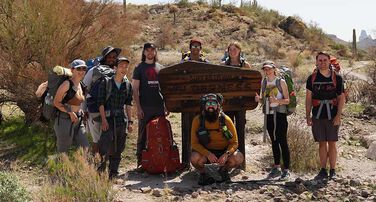
Your gift will provide opportunities for students to become outdoor leaders through hands-on education, sustainability training and community engagement experiences.
 Empower community resilience
Your generosity provides immediate and meaningful support to ASU students.
 Build the future of health
Your generous gift provides future physicians with the essential equipment and technology they need to learn, grow, and succeed throughout medical school.
 Inspire tomorrow's game changers
You help build an elite program for student-athletes that will shape their lives forever.
 Advance technology for good
Your generosity helps bring groundbreaking tools like virtual reality into classrooms and labs – technology proven to boost grades and improve learning overall.
A bold new approach to impact
ASU is uniquely committed — and uniquely equipped — to make a difference. Repeatedly ranked No. 1 in innovation, sustainability and global impact, we have proven the transformative power of the New American University.
Right now, we cannot be bystanders. We can’t let the planet become unlivable, watch democracy fade or allow health to remain a privilege. We can’t miss the power of technology or the potential of the next generation.
We must go where we’re needed, connect people across the world and take bold action. Stand with us and help shape a better tomorrow.
ASU Foundation News

Barbie partners with ASU FIDM on summer fashion camps
Barbie, the iconic fashion doll by Mattel Inc., and Edikted, an LA-based style-led contemporary fashion brand, are teaming with ASU FIDM to invest in the next generation of fashion leaders through supporting the school’s summer fashion camps. Each summer, ASU FIDM offers day camps at its…

California grad chooses a unique path to medical school
By Amanda LoudinMost pre-med students choose biological sciences as their major, but for Nya Clemons of Fontana, California, the logical choice was sports science and performance programming at Arizona State University.…

Annual {Ink}arcerated art exhibition returns to Arizona Center May 15
For Alexis Klemm and Madeline Boersma, “ink season” begins in the fall.Every October since they began working on {Ink}arcerated: Creativity Within Confinement, an annual art exhibit featuring the work of incarcerated individuals, the pair mentally prepare for a long journey — in some cases,…

ASU receives $10M gift to endow football coach position
Brian Swette loves college sports and what they mean to a university.“Success in sports is important for the university,” said Swette, who graduated from Arizona State University in 1976 with a bachelor’s degree in economics. “It enhances the college experience. It brings a sense of community and…

ASU supercharges AI research capabilities thanks to technology donation
Arizona State University is expanding its artificial intelligence research capabilities following a multimillion-dollar technology donation from Intel.The donation, part of ASU's Changing Futures campaign to advance technology for good, supports a larger university priority to strengthen national…

ASU, Delta Dental of Arizona collaborate on SMILE-AI program
Arizona State University and Delta Dental of Arizona are partnering to create the Student-centered Medical Instruction and Learning in Oral Health powered by Artificial Intelligence, known as SMILE-AI, at the John Shufeldt School of Medicine and Medical Engineering. The initiative,…

ASU’s Conservation Futures Academy expands to meet global demand for conservation workforce skills
Financial systems, emerging technologies and global policy are redefining how conservation work gets done, and Arizona State University's Conservation Futures Academy is expanding its portfolio of professional programs in response.Since its initial launch, the academy has enrolled more than…

Sun Devil Giving Day 2026 sparks generosity and inspires students
Arizona State University supporters came together for Sun Devil Giving Day on Thursday, March 19, donating to their favorite program, research, scholarship or student-support fund.Since 2013, Sun Devil Giving Day has been an annual opportunity for donors to make a difference in the lives of ASU…

Gift endows study abroad scholarship, broadening horizons for students
Across cultures and continents, travel has the power to shift perspective, deepen empathy and spark lifelong curiosity. In Arizona State University’s School of Human Evolution and Social Change, study abroad programs are designed to do just that by immersing students in environments that enrich…

ASU endowment reaches $1.7B, earns top 100 national ranking
Arizona State University’s endowment reached $1.7 billion in assets at the end of fiscal year 2025, placing it on the industry’s top 100 list of U.S. higher education endowments by asset size, according to newly released data. The endowment, managed by the ASU Foundation for a New…

Honors scholarship strengthens the way students prepare for the workforce
As the workforce continues to change, Barrett, The Honors College at Arizona State University is rethinking how honors education prepares students for life after graduation. Through a national initiative — the Advancing Honors Scholarship — the college is testing and…

$35 million gift advances ASU's global leadership in supply chain management
Arizona State University today announced a historic $35 million gift from the National Association of State Procurement Officials to elevate the role of procurement and strengthen the Department of Supply Chain Management at the W. P. Carey School of Business, which will be renamed the NASPO…

ASU medical school gains accreditation — and a new name
John Shufeldt knew he wanted to be a physician when he was 5 years old.“I realized early on that everyone should have a shot at health, no matter where they are in the birth lottery,” said Shufeldt, who would go on to become an emergency medicine physician and the founder of multiple health…

ASU announces new Global Institute for the Future of Energy
The idea had been tugging at him for years. Whenever Bob Zorich read headlines about energy policy or listened to debates that felt more like shouting matches than discussions, the same thought returned: People don’t really understand energy.It wasn’t their fault, he knew. For generations, the…

$100M renovation to energize fan experience at Desert Financial Arena
Desert Financial Arena is about to get a brand-new look.Arizona State University is embarking on a multiyear, multiphase renovation of the arena — home of the Sun Devils’ men’s and women’s basketball, volleyball, gymnastics and wrestling teams — with an estimated cost of $100 million…

Blackstone Charitable Foundation awards $3M to launch Blackstone Skilled Futures
The Blackstone Charitable Foundation has awarded a $3 million grant to launch Blackstone Skilled Futures in partnership with Arizona State University, Maricopa Community Colleges and local nonprofits. The program aims to increase access to high-quality training and workforce development, focusing…

Building a vibrant Mesa through medicine, arts and philanthropy
By Mary Raha and Sarah McCartyRuth Tan Lim — a board-certified pediatrician, philanthropist and longtime arts advocate — has dedicated more than four decades to caring for children and strengthening her community through creativity and education.Lim’s recent investment in ASU’s Media and…

Thunderbird at ASU launches fellowship focused on sustainable ocean governance
The world’s oceans cover more than 70% of the planet, driving weather, regulating climate, feeding billions and providing untapped economic potential. Yet they remain under increasing threat from climate change, pollution, overfishing and competing geopolitical claims.Rising sea levels threaten…

$115M gift — the largest ever for ASU — to establish School of Conservation Futures
When Rob Walton visited a friend in South Africa 25 years ago to tour a nature preserve, his friend told him getting involved with this kind of work was what Nelson Mandela told him “good guys” do.The comment struck a chord with Walton, who recalled fond childhood memories of camping with his…
ASU Foundation celebrates record-setting philanthropic impact
Arizona State University Foundation for a New American University marked a record-setting year of philanthropic impact, demonstrating how donors’ generosity is transforming lives, advancing research and strengthening communities.From July 1, 2024, to June 30, 2025, more than 113,000 individual,…